
An adviser’s view
Andy Burton, Financial Planner
Andy Burton is a Financial Planner at Amber River Shipman Wealth, known for helping clients cut through complexity and focus on what really matters to their financial future. With a holistic, long-term approach, he uses tools like cashflow planning to turn abstract goals into clear, practical plans.
When markets wobble, logic tends to leave the room. Phones ring more often. Portfolios are checked more frequently. And even the most level-headed investors find themselves asking the same question: “Should I just get out now and wait for things to settle?”
It’s happening again. Recent geopolitical tension between Iran and the US has rattled markets, headlines are relentless, and uncertainty feels uncomfortably close to home. For many investors, it’s not just numbers on a screen; it’s their future, their plans, their sense of security.
It’s a pattern Andy Burton, Financial Planner at Amber River Shipman Wealth, has seen repeated time and again through financial crises, political shocks, and periods of global instability.
“The main driver is panic,” he says plainly. “Nobody likes seeing their investments go down. Even after 20 years in the industry, I still look at mine sometimes and think, ouch.”
And that’s the key point – this isn’t just about markets. It’s about human behaviour.
For many investors, it’s not just numbers on a screen; it’s their future, their plans, their sense of security.
The moment logic gets overridden
Market downturns don’t just test portfolios, they test people. “What I hear from clients is: ‘It’s gone down… it’s going to go down more… I might lose everything,’” Andy explains. “It’s that fear of where it ends.”
It’s not entirely irrational. Loss simply feels worse than gain. A portfolio rising by 10% might feel reassuring, even expected. But a fall of just 3%? That’s when people start to worry.
Behavioural economists call it “loss aversion” – but in reality, it’s just human nature. We react more strongly to setbacks than to progress. The problem is that when investing, that instinct often drives exactly the wrong decision at exactly the wrong time; selling when markets fall, and only returning when things feel more comfortable again.
“People think they’re stopping the loss,” he says. “But actually, the moment you sell, you’ve locked it in.” This idea that losses are temporary unless acted upon is one of the hardest for investors to accept. Particularly now, when access to information is constant.
“Years ago, people didn’t see their portfolio every day,” Andy adds. “Now you can log in, check an app, read the news, it’s everywhere. That overload just amplifies the panic.”
And interestingly, he’s noticed a pattern. “The clients who don’t check all the time? They’re usually the calmer ones. The ones looking daily are often the most anxious.”
Why doing nothing often wins
If panic is the problem, patience is the solution, but that’s easier said than done.
One of the most powerful ways Andy explains this to clients is by pointing to history. Not abstract theory, but something recent and undeniable: COVID. “You can literally see it on a chart,” he says. “As the chart shows, markets fell sharply at the onset of COVID-19, before rebounding just as quickly in the months that followed. It’s a classic V-shaped recovery
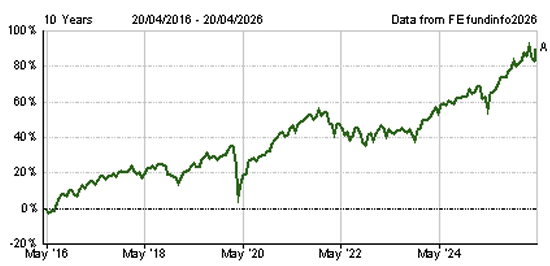
Data provided by FE Fundinfo
It’s exactly the kind of pattern seen time and again in market data: short-term falls are a normal part of long-term investing. In fact, it’s not unusual for markets to drop by around 16% at some point during the year, even in years that finish in positive territory.*
In other words, volatility isn’t an anomaly. It’s the price of growth. “Every downturn I’ve seen,” Andy says, “has been followed by recovery. That’s the pattern.”
The real danger isn’t the fall, it’s missing the rebound. Over the long term, a surprisingly large share of returns is delivered in just a handful of days. Miss them, and the impact is stark. Data shows that missing just the 10 best days in the market can dramatically reduce overall returns, and the more you miss, the worse the outcome becomes.*
“Those recovery days? You can’t predict them,” Andy explains. “If you’re not invested when they happen, you’ve missed it.”
* Data sourced from a James Hambro & Partners report produced for Amber River Shipman Wealth.

The illusion of waiting for “the right time”
It’s a common instinct: sit in cash, wait for stability, then invest. The problem? Stability is only obvious in hindsight.
“If anyone could time the market perfectly,” Andy says, “they’d be very rich. But even the best fund managers don’t get it right all the time.”
That’s why the old cliché still holds up: it’s not about timing the market, but time in the market. “Delaying means you might miss the recovery,” he adds. “And that can make a huge difference over the long term.”
This is where the psychology becomes particularly counterproductive. “Everyone knows the phrase ‘buy low, sell high’,” Andy says. “But in reality, people tend to do the opposite. They sell when things fall and buy when things feel safe again, when prices are already higher.”
The hidden risks of “playing it safe”
For many investors, moving to cash feels like the sensible option during uncertainty. But that safety comes with its own risks, ones that are often less visible.
“The biggest one is inflation,” Andy says. “Your money might look like it’s staying the same, but in real terms, it’s losing value.”
Even with relatively strong savings rates, the long-term picture is less reassuring. “Cash rarely outpaces inflation over time,” he explains. “And historically, investments have outperformed cash in the majority of years.”
That aligns with broader data: equities have beaten cash in most long-term periods, making cash a poor strategy for growth-focused investing.
There’s also a second, less obvious cost. “If you’re sitting in cash, you’re not just avoiding losses, you’re also missing gains,” Andy says. “And those gains can come quickly.”
The adviser’s role: talking people off the ledge
So what actually works when clients are on the brink of making a poor decision? Not jargon. Not generic reassurance.
Instead, Andy leans heavily on something more tangible: personal context. “One of the most powerful tools we use is cash flow planning,” he explains. “We can model different scenarios, even market crashes, and show clients they’re still on track.”
That shift, from abstract worry to concrete evidence, can be transformative. “Rather than saying ‘don’t worry’, we can show them: here’s your plan, here’s your future, and you’re still okay.”
He also brings the focus back to something many investors lose sight of in volatile moments: why they invested in the first place. “If someone is saving for retirement in 20 years, what happens this month doesn’t really matter,” he says. “But it feels like it does if you’re only looking at the short term.”

Case study: staying the course paid off
During the COVID market downturn, Anthony and Rohan, a couple nearing retirement, planned to withdraw their ISA investments and take tax-free cash from their pensions, concerned about the impact on their future.
Andy met with them to revisit their financial plan. Using cashflow modelling, he showed they remained on track to retire despite the market fall. He also explained that withdrawing funds would lock in losses and create unnecessary tax consequences.
With this clarity, they chose to stay invested.
At their next review, markets had recovered and their position had improved. Their business was later sold, the proceeds structured tax-efficiently, and they retired as planned, including a long-awaited trip to New Zealand.
Had they acted differently? They would have locked in losses, missed the recovery, and worsened their tax position over the long term.
So, what separates successful investors?
Ask Andy, and the answer is almost disappointingly simple. “Patience,” he says. “It’s not exciting, but it’s true.”
The investors who tend to do well over time aren’t the ones making constant adjustments. They’re the ones who:
- Stay focused on long-term goals
- Avoid reacting emotionally to short-term noise
- Trust the process, and their adviser
- And, perhaps most importantly, they don’t check their portfolio every day.
“If looking at it is making you anxious,” Andy says, “take a step back. Check it less often. Give yourself some space.”
What this means for investors
Market volatility is uncomfortable, but it’s not unusual. The real challenge isn’t predicting what markets will do next. It’s managing how we respond when they move.
Because time and again, the pattern repeats: Markets fall. Investors panic. Some sell. Markets recover.
And those who stayed invested? They move forward. Those who didn’t? They often spend years trying to catch up.
Or as Andy puts it, quoting Warren Buffett: “The stock market is a mechanism for transferring wealth from the impatient to the patient.”
Not complicated. But far from easy.
Get in touch
If recent market volatility has left you questioning your next move, you’re not alone in feeling uncertain. But making decisions in the heat of the moment can have long-term consequences. As Andy Burton explains, successful investing is often less about reacting quickly and more about staying focused on the bigger picture.
At Amber River, our advisers can help you step back from the noise, understand your options, and build a financial plan designed around your long-term goals, not short-term headlines.
To talk to one of the team, or to arrange an appointment to discuss how we could help you, please call 0800 915 0000, or alternatively use our contact form here.
This is important:
We’ve written this article purely for general educational purposes. It’s not investment advice, or an invitation or inducement for you to invest your money. The information in the article can go out of date over time too – thanks to law and tax rule changes.
Your situation will be unique to you, and that’s why you should always seek personalised advice from a qualified financial adviser before taking any action.