

Written by:
Alex Chappell
Head of Investments at Amber River DB Wood
Economic growth has generally remained resilient, company earnings have been broadly supportive and unemployment remains low in many major economies.
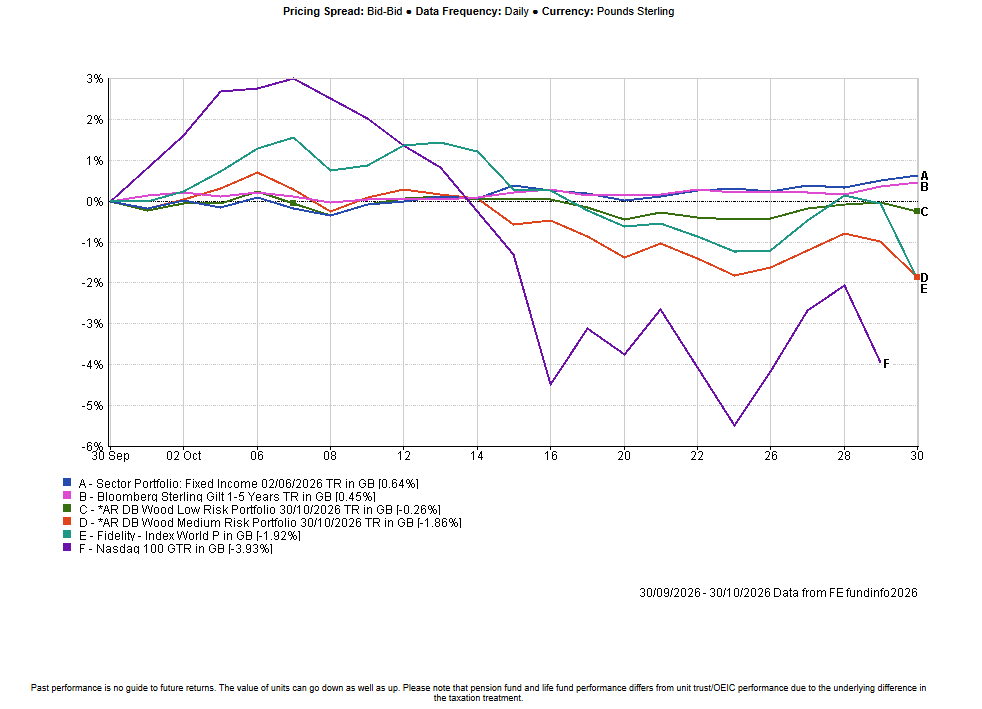
The final quarter of the year can be difficult to navigate as investors take profits and reposition ahead of year end. In October, uncertainty ahead of the UK election and the US midterms in early November added to concerns about the ongoing conflicts in Ukraine and Iran. Those conflicts affected energy prices and heightened inflation expectations—a difficult combination for both bonds and equities. Markets sold off sharply before recovering some ground, though volatility was consistent throughout.
The UK Budget offered very little in terms of change, in the main it was not as fiscally challenging as markets had feared, so as a result the UK bond market has seen a slight improvement in capital values since the Chancellor spoke.
In addition, the US elections were influencing markets in October, and the results didn’t make good reading for Trump with the Democrats dominating, though with greater conviction than was expected. The initial market response was one of relief, at least in terms of the expectation that a divided house will mean little policy change, and that in turn should help with a more stable fiscal outlook for the US. This reflects the idea that when Congress is more balanced (in this case the Democrats having control of both sides, but Trump having a presidential veto), government policy is largely static, taking away the chance of policy shocks and sudden change. That said, the Democrat party is pro regulation of AI firms, so there is an increased fear that this may adversely affect the forward valuations of companies within the tech sector. This was noted by heightened volatility in the AI space, and October was a month where the technology sector sold off significantly.
Other than the events above, the major drivers for markets has been rising geopolitical tensions, causing oil to climb from $90 a barrel to more than $115 mid-month before easing to around $92 at the time of writing this week. This journey increased forecasts for inflation, which was tough for bonds, and led to more speculation around further increases to the direction of interest rates.
That said, although October was a difficult month, our portfolios behaved with resilience. You will note below that our fixed income portfolio – a major part of our Lower risk portfolios, outperformed the UK Government Bond market, though all our portfolios were lower on the month due to the sell off in global equities.
We expect upcoming UK economic data to point to low growth rather than an imminent recession.
So what does this mean?
Many of the factors influencing markets reflect expectations about the future rather than evidence of a significant deterioration in the global economy. Economic growth has generally remained resilient, company earnings have been broadly supportive and unemployment remains low in many major economies. We expect upcoming UK economic data to point to low growth rather than an imminent recession. The key challenges remain around inflation and interest rates, and they in turn are driven by geopolitical decisions. A substantial rise in either could threaten growth and weigh on both equities and bonds. However, if policymakers judge that inflation is being driven by oil and gas supply pressures (and not consumer demand) and otherwise inflation and price rises elsewhere remain contained, we see scope for a more positive outlook.
In summary, markets continue navigating questions around AI investment, inflation expectations, geopolitical developments and government policy. Most of this criterion has been with us for the whole of this year and longer. While these factors are frustrating, (the latter two are very difficult to predict), we continue to see considerable value in our portfolios on a 12-month view and beyond. In large part this is because our forward income generation reached an all-time high in October, and although we have seen a recent decline in portfolio values, our portfolio range still sits very close to Summer and Autumn all-time highs, so from that perspective October’s volatility has not materially changed our investment outlook, and consequently we remain focused on delivering a strong end to the year, hopefully not just on a relative basis.
Regular readers of our blogs will also know that once or twice a year we do a Question the Committee blog, where we invite your questions, pose them to our investment team and share our thoughts and responses. In this regard we plan to issue one before the end of the year, on 11th December, so please check your inbox for more details on how to submit a question soon.
OFFICE
Amber River DB Wood
Our team at Amber River DB Wood includes Chartered financial planners who look after clients across the East Midlands and beyond.
Join our mailing list
Small, but important print
We adhere to the FCA’s principles of Treating Customers Fairly (TCF). Read more here
Amber River DB Wood is a trading name of DB Wood Ltd, which is authorised and regulated by the Financial Conduct Authority no: 209530. Registered in England & Wales. Registration No. 4312250. Registered Address: Potterdyke House, 31-33 Lombard Street, Newark, Nottinghamshire NG24 1XG. http://www.fca.org.uk/register
The Financial Conduct Authority does not regulate National Savings or some forms of mortgage, tax planning, taxation and trust advice, offshore investments or school fees planning.
Please read our Privacy Statement before completing any enquiry form or before sending an email to us. You’ll find our Client Privacy Notice here.
For help if things go wrong click here