

Market Review
After a good start to the year, (despite the volatility within investment markets), our view looking out on Quarter 3 was one of cautious optimism, our rational being based around the 60-day ceasefire that was agreed in the middle of June. Since the outset of this conflict, we have been of the view that the restrictions around shipping via the Straits of Hormuz would not last long into the back end of 2026. Following the ceasefire, oil started moving through the Middle East and prices fell back towards $70 per barrel. The major parts of our portfolio’s (bonds and equity markets) rallied. At this point our central investment case was looking well positioned….
The optimism we had in June now looks misplaced. The ceasefire agreement signed in mid-June was disregarded and tensions flared up again before July had closed out, and ever since we have been in an impasse. Other than a 6 week period across June and July, oil has largely been priced at around $100 since mid-March, so naturally we have started to see a feed through into inflationary pressure. It isn’t that inflation is particularly high – the latest reading for August at 3.1% annualised, but it is up from 2.6% in June, and well up from the 2% we were expecting to see at this point in the year all else equal.
Central Banks around the world have started to react to control the threat of rising inflation. It doesn’t feel that long ago that we were sat here explaining that markets were pricing interest rates to fall back to around 3% by now. A year on and they are now expecting increases, with UK and US rates forecast to head back to 4.25% during Q1 2027. So far, the Bank of England has held off, though Central Banks like the US Federal Reserve and the European Central Bank have started to move interest rates higher.
Oil and energy assets have performed strongly, and precious metals have picked up a little after a very challenging first half of the year when the yellow metal fell by 25% from February’s highs.
From a numbers perspective, after a strong first few weeks of the quarter, equity markets have largely traded sideways, held up in the main through returns from the tech space, where earnings continue to look solid. Globally, government bond markets have sold off steadily since March, and that pace has increased in the last two weeks, with investors demanding more return to hold debt across most of the world. Corporate debt has remained stable as fears of a recession (for now) look less likely given the steady nature of economic data coming out of the developed economies.
Whilst equity and bond markets have struggled to sustain the traction from the start of the year, commodity markets have had a better time. Oil and energy assets have performed strongly, and precious metals have picked up a little after a very challenging first half of the year when the yellow metal fell by 25% from February’s highs.
Logically we would have expected markets to react as they have given the breakdown of the ceasefire. So, we are not surprised, we are just disappointed from an investment perspective (obviously also from a humanitarian one as well), that our return forecast this year is somewhat challenged and dictated by something we can’t predict. That said, what we also know is that there are now some exceptional opportunities on offer, and our growth story is bigger than it has ever been even if it is a little deferred, and we might have to be patient a little while longer.
Portfolio Review
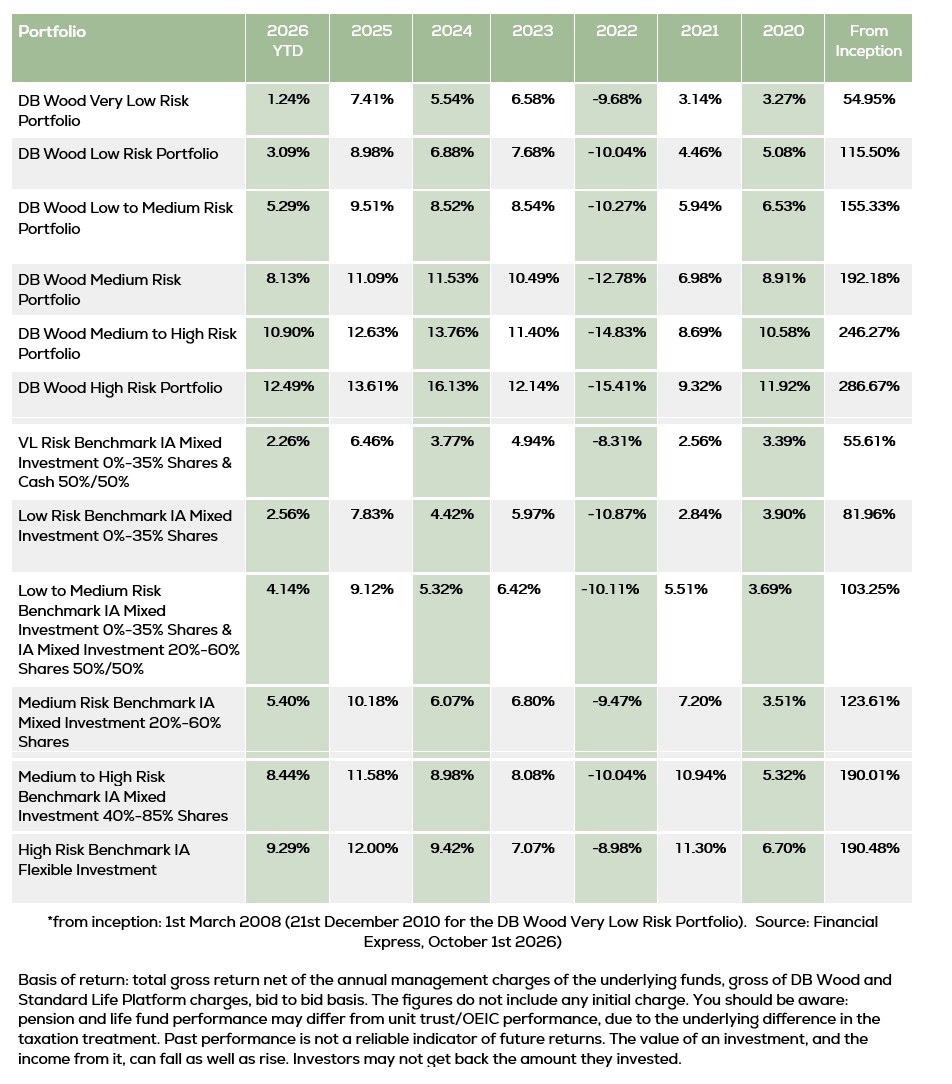
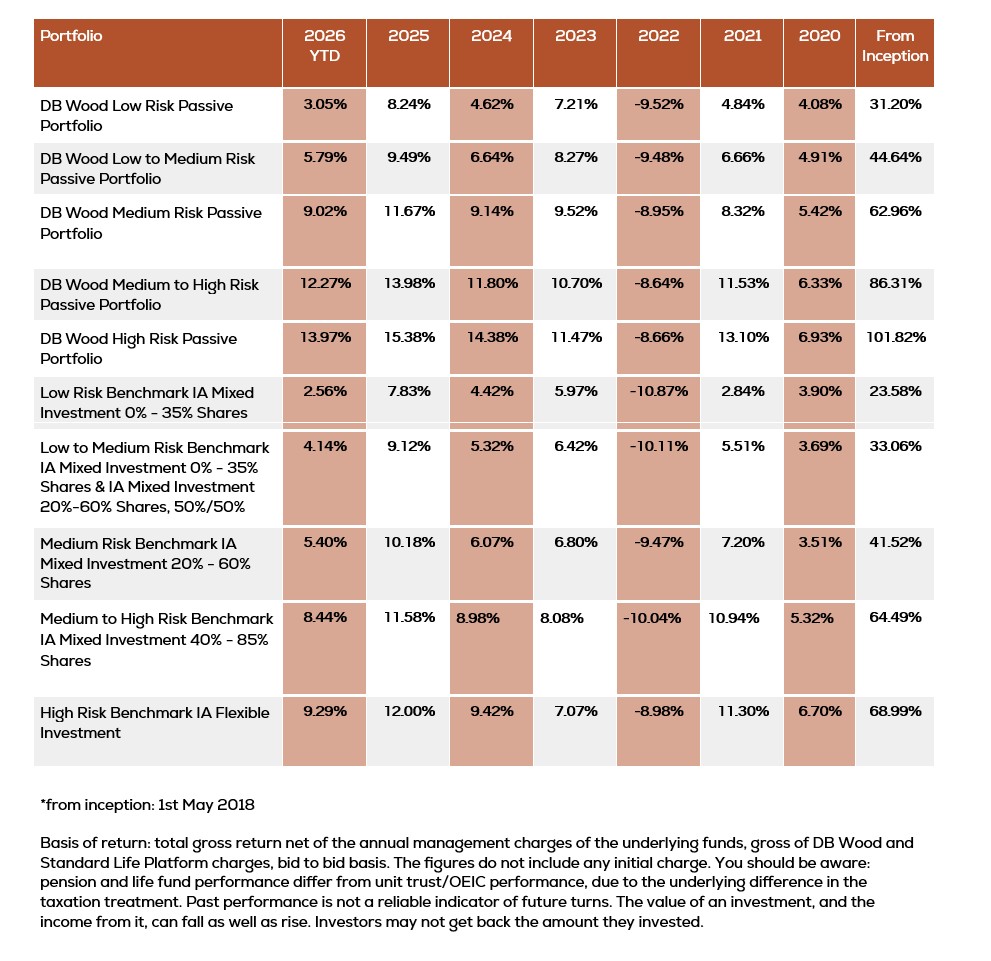
With a mixed outcome for investment markets, it again probably won’t be a surprise that the portfolio range traded flat across the quarter. When added to the first half of the year the portfolios continue to look solid in 2026 year-to-date however, with returns between 3.09% (Low Risk) and 12.49% (High Risk). All our portfolios have outperformed their respective benchmarks, and most are on track to deliver our financial planning assumptions within our cashflow models.
Blended Active
Dynamic Passive
Market Outlook
As we often try to outline in these blogs, when making investment decisions we try to visualise the future with a number of scenarios. There are times where many factors matter to markets, and you have to consider the interconnected weave of information, and others where only a couple of key things matter. Right now, we are in the latter camp, and one of the obvious variables we factor in to our scenarios is whether in 6 months’ time we still have tensions in the Middle East (and elevated energy prices) or not.
At the current time, the media narrative would say there is close to no chance of a deal anytime soon, though it is worth remembering that it felt the same in April. Future markets are pricing oil being at $100 dollars a barrel in late 2026, to $70 dollars a barrel 12 months later. In that scenario, inflation and interest rate expectations adjust, they increase in the near term and fall away into the back end of next year. Markets anticipate prior to that happening of course, just like we have seen in the recent change in bond pricing.
To give you some context, a 5-year loan to the UK Government is currently paying investors an income of 5% each year guaranteed, whether they like it or not. If this time next year future interest rate expectations are as they are now, then we will just pick up a return of 5% over the year from the investment. If however, the market is pricing interest rates back to today’s rates, then you can add a further 3.75% on top of that income making the total return 8.75%. In that environment we would expect equity markets to produce circa 10% plus, and therefore total returns for lower risk investors should comfortably be 8-10% over the coming 12 months, all else equal. That is the positive scenario.
Alternatively, if the pending French and UK budgets are fiscally challenging, then we could see bonds fall further, particularly if there is no easement in the Middle East position for a further 6 months. Given that scenario we could see bond yields rise further. In our view bond yields have not got much further to rise before they begin to trouble equity valuations, and stock markets would likely also sell off in that scenario. That said, we think both French and UK bonds are already front end loading a negative budget outcome, so a fiscally responsible budget should see an improvement in bond valuations. Our blog in two weeks’ time will focus on the upcoming UK budget, and of course if you have any questions in the meantime, please do not hesitate to contact us at questions@amberriverdbwood.com.
Have a great weekend all!
OFFICE
Amber River DB Wood
Our team at Amber River DB Wood includes Chartered financial planners who look after clients across the East Midlands and beyond.
Join our mailing list
Small, but important print
We adhere to the FCA’s principles of Treating Customers Fairly (TCF). Read more here
Amber River DB Wood is a trading name of DB Wood Ltd, which is authorised and regulated by the Financial Conduct Authority no: 209530. Registered in England & Wales. Registration No. 4312250. Registered Address: Potterdyke House, 31-33 Lombard Street, Newark, Nottinghamshire NG24 1XG. http://www.fca.org.uk/register
The Financial Conduct Authority does not regulate National Savings or some forms of mortgage, tax planning, taxation and trust advice, offshore investments or school fees planning.
Please read our Privacy Statement before completing any enquiry form or before sending an email to us. You’ll find our Client Privacy Notice here.
For help if things go wrong click here